

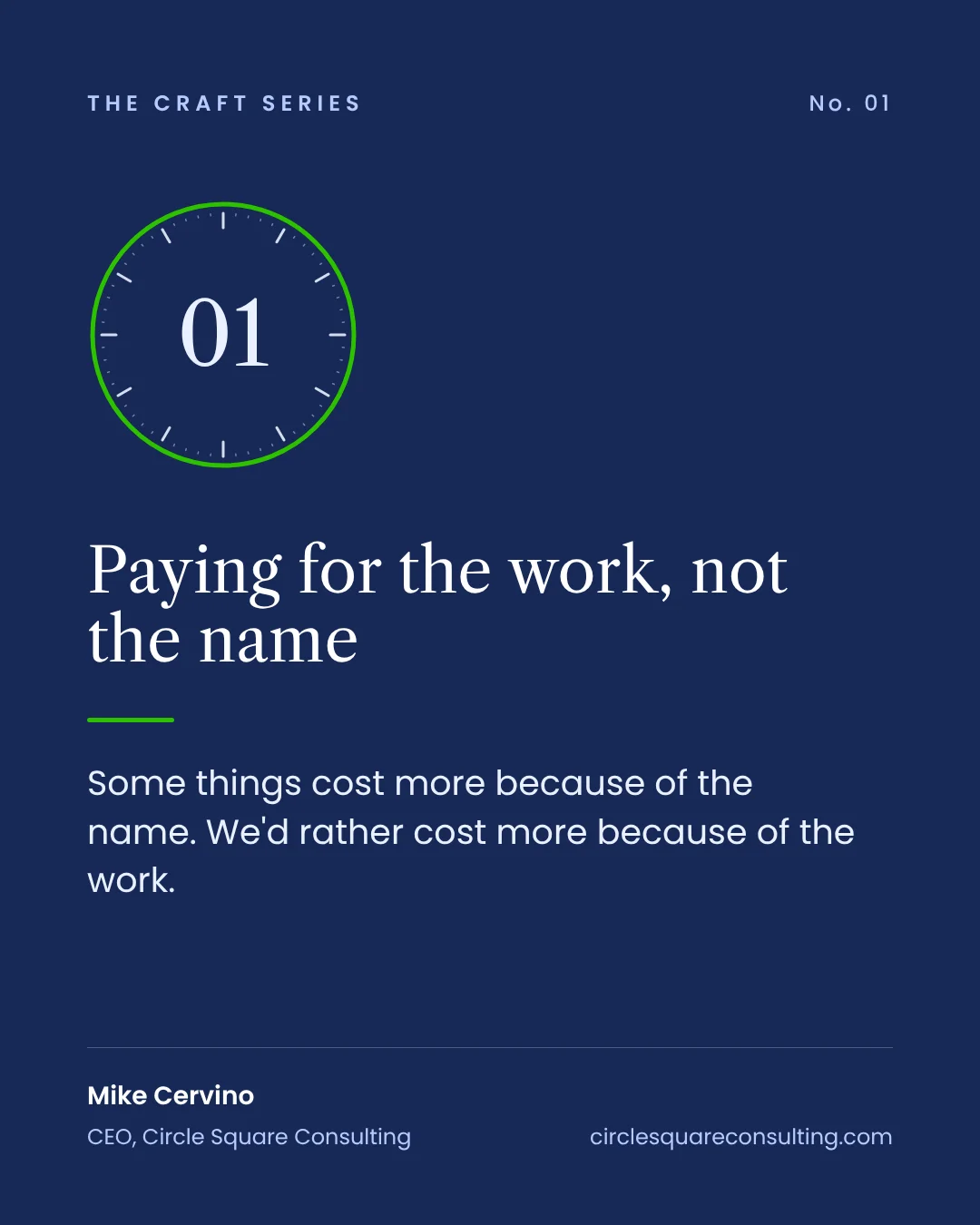
Some things cost more because of the name on them. Circle Square only wants to cost more where the work is better, so we wrote down exactly what that means.
Ric Wallace and I started Circle Square almost six years ago. We’d both spent years around managed IT, and we kept seeing the same patterns. Firms got bigger and service got thinner. Private equity was buying up providers and merging them, and the client usually ended up further from the people doing the work. That trend has only picked up since.
We wanted to build something different. For a while, I had trouble saying what “different” meant without sounding like every other brochure.
Two reasons something costs more
The clearest way I’ve found to say it comes down to why people pay more for anything.
Sometimes you pay more for the name. Take the label off and you’d have a hard time explaining what the extra money bought.
Other times you pay more because the thing is better made. You can point to it: the materials, the time, the person who did the work, the way it holds up after years of use. You could explain the price with the label cut off.
I want Circle Square to be the second kind. If a client pays us more than they’d pay someone else, they should be able to point at exactly why. The engineer who knows their environment. The written plan. The backups that get verified every day. The review where we sit down and talk about where the business is going.
Who you answer to shapes the work
The lesson that took us longest to learn was about ownership.
In our early years, Circle Square had outside shareholders. They were purely investors. I don’t say that as a knock on them. They just didn’t understand managed IT, and they didn’t see that this is a service business, where what you’re really selling is the work your people do for someone else every day. Most of all, they didn’t see that the client is the only thing that matters.
You could hear it in the conversations. Every one came back to profitability, and the path they had in mind usually meant giving up some quality somewhere. A cheaper hire here. A few more clients per engineer there. Each request sounded reasonable on its own. Added up, they would have changed what we were.
So Ric and I bought them out. It wasn’t a small decision, and I’d make it again.
Since then, the only people we answer to are our clients. That has made a lot of decisions simpler, because every one of them gets the same question: is this right for the client?
What that has meant so far
It’s meant every client gets the same standard, whether they’ve been with us since day one or signed last week. It’s meant matching each client with a primary engineer who has the experience and the room to own the account properly. And it’s meant we’ve never lost a client.
I’m proud of that last one, and I don’t take it for granted. A record like that only holds if the work behind it holds every day.
Why we wrote it down
On the flight line, where I spent six years as a KC-10 crew chief at McGuire Air Force Base, the rule was check everything, assume nothing. Good intentions didn’t count for much. The checklist did, and every job was signed for.
That’s why we wrote ours down. A standard you can’t check is just a story. The Circle Square Standard is ten commitments under one heading: “What every client can hold us to.” It covers starting with your business before your technology, a written plan for every client, a named person who owns your account, response times on a published clock, and a minimum standard every environment we manage has to meet. It also lists what we won’t do, like promise numbers we don’t control.
Over the next several weeks I’ll walk through it one commitment at a time. Some of it comes from the flight line, some from the clients who’ve taught us the most, and some from things we got wrong early and fixed.
If you’re shopping for IT support right now, or you’re just curious how a firm like ours thinks about this, I’d be glad to talk.
One standard. Every client. The door is always open.
Read the ten commitments every Circle Square client can hold us to, and what we won’t do. circlesquareconsulting.com/the-standard